
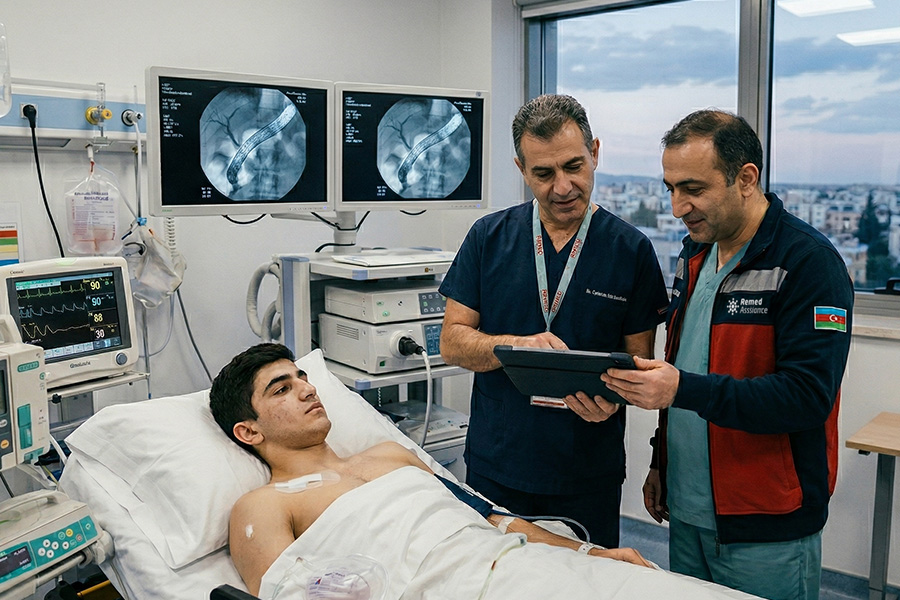
Life-Saving Medical Operation in Cyprus: A Young Athlete’s Race Against Time
International sports events involve high physical intensity and inherent risks. In such environments, rapid response, accurate medical assessment, and effective coordination are critical in managing traumatic injuries. This case, which occurred during the European Karate Championship in Cyprus in February 2026, clearly demonstrates the importance of international medical assistance services.
Initial Incident and Diagnosis
An athlete from the Azerbaijan National Karate Team sustained a severe abdominal injury during a match following a strong blow.
After receiving initial on-site medical care, the patient was transported by ambulance to Limassol General Hospital.
Initial assessment revealed that the injury was far more serious than a superficial trauma.
Further diagnostic investigations confirmed:
- Severe pancreatic duct injury
- Potential vascular complications
The condition was considered life-threatening, requiring urgent specialized intervention.
Emergency Intervention
The patient was immediately transferred to Nicosia General Hospital, one of the few facilities in Cyprus capable of performing advanced procedures of this type.
During a late-night emergency procedure:
- ERCP (Endoscopic Retrograde Cholangiopancreatography) was performed
- A stent was placed in the damaged pancreatic duct
- The patient’s condition was stabilized
This timely intervention prevented the development of severe complications.
Surgical Management
Despite initial stabilization, the patient required further surgical treatment.
On 11 February, a planned operation was successfully performed, involving partial pancreatic resection and placement of surgical drains. The procedure was completed without complications.
Over the following two weeks, the patient’s condition gradually stabilized.
Remed Assistance’s support services transforming a high-risk situation into a life-saving operation.
Throughout the case, Remed Assistance ensured:
- Continuous coordination between medical facilities
- Communication with treating physicians
- Arrangement of financial guarantees
- End-to-end case management
Once the patient was deemed fit to fly, a medical repatriation was organized.
According to the fit-to-fly assessment, the patient was able to travel seated in the front rows of a commercial aircraft, accompanied by a medical escort.
Following rapid organization of the flight and medical support, the patient was successfully repatriated to Azerbaijan on 5 March 2026.
This case highlights the critical importance of rapid decision-making, accurate medical direction, and efficient international coordination in managing complex medical emergencies.